
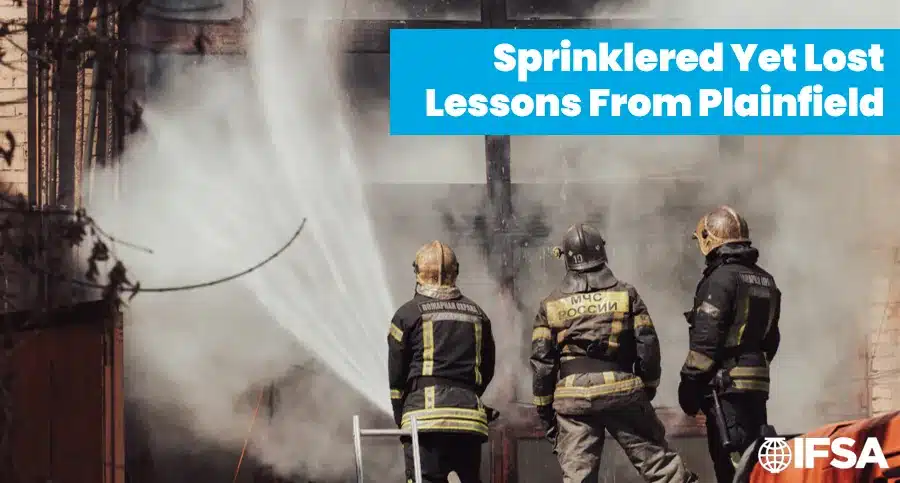
The National Fallen Firefighters Foundation analysis of the Plainfield mega-warehouse fire shows how a sprinklered, well-maintained building can still be lost. This month IFSA examines where storage fire protection falls short of the modern warehouse and what it takes to close the gap.
At 11:52 on a morning in March 2022, an air-sampling smoke detector on the second level of a four-level pick module sent the first alarm from an order fulfillment center in Plainfield, Indiana. The building covered about 106,300 m² (1,144,000 ft²), and the pick module inside it held roughly 102,000 m² (1.1 million ft²) of storage floor spread across its four levels. Within about a minute, sprinklers under the mezzanine deck were flowing water. By the time firefighters arrived at 12:10, the fire had been controlled and confined to a small area, and crews finished it with a single hose line before 12:22.
What happened next is documented in the Mega-Warehouse Fire Incident Report, an analysis coordinated by the National Fallen Firefighters Foundation (NFFF) and released in February 2025, with contributors from NFPA, FM, the ATF and the Indiana State Fire Marshal. With the fire out and the building full of cold smoke, operations turned to property conservation. Crews went looking for the sprinkler control valves, and the fire pump was shut down. About ten minutes later, fire broke through the roof near the middle of the building. Within 60 to 90 seconds, heavy smoke had descended more than 12 m (40 ft) to the floor, and three firefighters still inside the racking survived a Mayday only by following their hose line back to the door. The restarted fire pumps could not deliver enough water, and the building and its contents, a loss estimated at more than USD 500 million, were destroyed.
The most important finding in the NFFF report is not about the firefighters. It concludes that their actions were reasonable and consistent with NFPA 13E and FM training, and that the fire protection systems appear to have been well designed and properly maintained. The probable explanation lies in the design concept. The sprinkler calculations for the pick module treated its four levels as independent fire areas. The water supply, sized for the ESFR sprinklers at the roof, did not have the capacity to supply the in-rack control mode sprinklers and the ESFR sprinklers operating at full design demand at the same time. The analysis concludes that fire most likely found a path upward through openings in the mezzanine decks early in the event and smoldered on an upper level, undetected, while the sprinklers controlled the original fire below. The report describes this as a failure of the overall risk assessment and design concept, more than a failure of the sprinklers to perform as expected.
That distinction matters for everyone who designs or approves storage buildings. The sprinklers did what they were designed to do. The design had not anticipated what the building could do.
The Fire Protection Research Foundation reached a related conclusion from the fire service side of the problem. Its December 2024 report, Identifying Challenges to the Fire Service Response in Storage Facilities, lists Plainfield among recent storage fires in which the facility had outpaced fire service tactics and training, and it notes that NFPA 13E does not account for the design of modern storage facilities. Among its research recommendations is a study of whether sprinklers in some storage buildings should be designed to extinguish a fire rather than only control it. Plainfield shows why that question matters. A control-mode design assumes someone will finish the fire, and in a building of that size the fire service may not be able to.
Plainfield is one building. The conditions behind it are now found in storage buildings on every inhabited continent, where land cost and e-commerce have pushed storage upward and inward. Automated storage now fills entire buildings and packaging has shifted toward plastics. Lithium-ion batteries sit on the shelf as product and in the aisle as the power source for the equipment that moves it. Each of these changes can be managed with water. None of them can be managed by a design that assumes the fire will stay where the drawings put it.
What the record shows
The United States publishes the most complete public data, and it describes a severity problem rather than a frequency problem. According to the National Fire Protection Association (NFPA) report Warehouse Structure Fires (February 2026), U.S. fire departments responded to an estimated 1,544 warehouse structure fires per year from 2020 through 2024, or about four a day, and direct property damage averaged USD 314 million a year. Fires between midnight and 6 a.m. accounted for 18 percent of incidents but 40 percent of that damage. A lightly staffed building at night loses its earliest detector, which is a person, and the sprinkler system becomes the entire first response.
Where sprinklers are present and the fire is large enough to operate them, the record is strong. NFPA’s U.S. Experience with Sprinklers (April 2024), covering 2017 through 2021, reports that in warehouses other than cold storage, sprinklers operated in 90 percent of such fires and were effective in 96 percent of the fires in which they operated. When sprinklers fail to control a fire, NFPA attributes most of those outcomes to the condition of the system rather than to water as an agent, and in warehouse properties the leading coded cause is a system that had been shut off. The agent is rarely the weak point. The weak point is the condition of the system on the day of the fire. Plainfield belongs to a second and harder kind of failure, in which a maintained system meets a fire its design did not anticipate.
What this month will cover
This October, IFSA will focus on the challenges of a modern storage occupancy. We’ll look closer at commodity classification, because every storage design rests on knowing what is being stored and recognizing when that has changed. It then turns to lithium-ion batteries, first as a stored commodity and then through a horizontal sidewall sprinkler listed for rack storage and tested with lithium-ion batteries.
Automated storage follows. Retail occupancies come next, where high-piled storage sits behind the sales floor and sometimes directly above the customers. Refrigerated warehousing brings its own water problem, because the pipe that must deliver water runs through space kept below 0 degrees C (32 degrees F).
Buildings with ceilings above 13.5 m (45 ft), or with multi-level pick modules like the one in Plainfield, test the limits of ceiling-only protection and of the water supply behind it, and sloped roofs over storage add a further complication. The month closes with the condition of the system on the day of the fire, from impairments that are never cleared to the flue spaces that operators fill because nobody told them the empty space was part of the fire protection. It also returns to the question Plainfield left for the industry: how anyone standing in a smoke-filled building decides that the fire is out and the water can stop.
Why this matters now
None of these topics argues against water. Water, delivered early and in the right pattern, remains the agent with the test data and the loss record to support it, and every document in this series, from NFPA 13 to the FM Global data sheets, is built on that foundation. What each topic argues for is a system kept as current as the building it protects.
A commodity reclassified without a design review and a mezzanine deck whose openings nobody thought to protect are both ordinary features in the life of a storage building, and either one can decide the outcome of a fire long before anyone arrives to fight it. The sprinkler system in a storage building is designed once. It has to be kept true every day the building operates.
References
- Fire Protection Research Foundation. Identifying Challenges to the Fire Service Response in Storage Facilities. Final report, December 2024.
- McGree, T. U.S. Experience with Sprinklers. National Fire Protection Association, April 2024.
- McGree, T. Warehouse Structure Fires. National Fire Protection Association, February 2026.
- National Fallen Firefighters Foundation. Mega-Warehouse Fire, 9590 Allpoints Parkway, Plainfield, Indiana: Incident Analysis (2024 Mega-Warehouse Fire Incident Report). Released 27 February 2025.
- National Fire Protection Association. NFPA 13, Standard for the Installation of Sprinkler Systems. 2025 edition.
- National Fire Protection Association. NFPA 13E, Recommended Practice for Fire Department Operations in Properties Protected by Sprinkler and Standpipe Systems.

Mark E. Fessenden, MBA
Mark E. Fessenden, MBA is the Managing Director and CEO of the International Fire Suppression Alliance (IFSA), where he leads the global advancement of water-based fire protection. For more than three decades he has devoted his career to developing innovative technologies that address the industry’s most pressing challenges.