
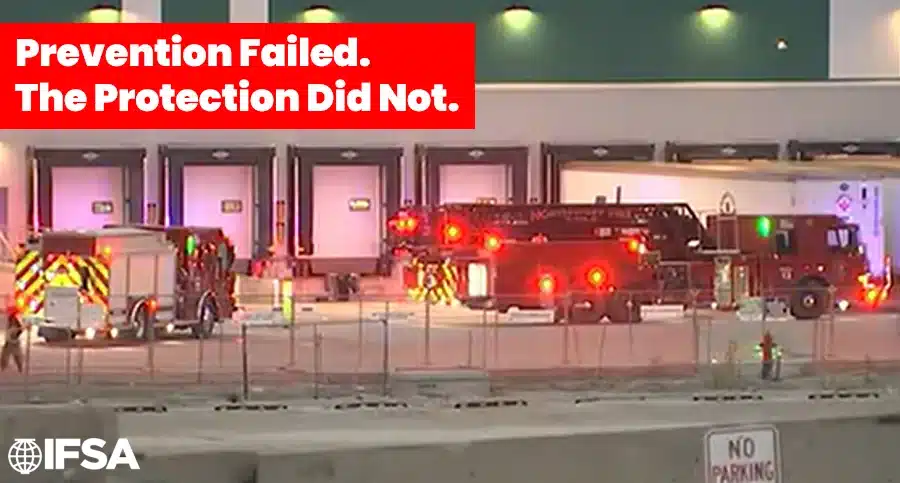
Fire officers who have worked industrial districts at night know the pattern of a late alarm. Someone smells smoke, looks for a supervisor, walks the area a second time to be certain of what he is reporting, and only then places the call. By the time the first apparatus turns onto the property, the fire has had ten or fifteen minutes of unopposed growth. The lithium-ion battery fire at De Soto, Kansas, on 29 July 2026 did not follow that pattern, and the reason it did not is the subject of this article.
The De Soto battery fire: what happened
Northwest Consolidated Fire District crews were dispatched shortly after 2:00 a.m. to an automatic waterflow alarm at the Panasonic Energy facility at 10301 Astra Parkway. Plant personnel had already evacuated on the fire alarm activation by the time crews arrived. Firefighters entering the building found smoke and upgraded the response to a building fire, then located burning batteries within battery racks in a testing area of the plant.
The fire district reported that the fire was contained to the affected battery racks and that the building automatic fire suppression system operated as designed, limiting the damage. Crews extinguished the remaining fire and supported overhaul and removal of the damaged equipment. No injuries were reported. A company spokesperson credited the response of the fire district and said that the day shift would operate with minimal disruption while an investigation proceeded.
Why the waterflow alarm came first
The waterflow alarm was the initiating signal. Water was already moving through the sprinkler system piping before any occupant reported a fire and before any apparatus left the station. At two o’clock in the morning a manufacturing building carries a fraction of its daytime staffing, and test cells are frequently unoccupied by design. Detection by a person was never the likely path here. The sprinkler system provided both the detection and the control, and the fire department arrived to a problem that had already been bounded.
How sprinklers control a lithium-ion battery fire
Lithium-ion cells in thermal runaway present a hazard that differs from ordinary combustibles in one important respect. The reaction is self-sustaining inside the cell and supplies its own oxidizer, so extinguishment in the conventional sense is not what water is doing when it lands on the array. The work is heat removal. Water absorbs approximately 2,260 kJ/kg (970 BTU/lb.) in changing from liquid to vapor, and that absorption is what holds the cells adjacent to a failed cell below the temperature at which they enter runaway themselves. A sprinkler system that wets the surrounding array quickly enough interrupts cell-to-cell propagation. Containment to the affected racks is the visible evidence of that interruption.
The guidance for this hazard has developed quickly, although most of it addresses installed energy storage rather than the manufacturing and test environment. NFPA 855 sets installation requirements for stationary energy storage systems, UL 9540A defines the test method used to characterize thermal runaway fire propagation, and FM Global Data Sheet 5-33 addresses protection of lithium-ion storage arrangements. Battery testing floors sit awkwardly between these documents. Cells are present in quantity, and the arrays are arranged for the convenience of test technicians rather than for the discharge pattern of ceiling sprinklers.
The Morris, Illinois battery fire: the same hazard unprotected
The value of what happened in De Soto becomes legible only against a case where the protection was absent. Morris, Illinois, provides one.
On 29 June 2021, a fire began in a former paper mill at 900 East Benton Street occupied by Superior Battery. The building was a single-story brick structure roughly 91 by 122 meters (300 by 400 feet) and about 6 meters (20 feet) high, holding as much as 82 tons (90 tons) of lithium batteries along with lead-acid batteries, nickel-cadmium batteries, solar panels, roofing materials and general merchandise. The City of Morris had received no business license application for the site and did not know the company existed, or what the building contained, until the fire.
The public record contains no account of an automatic sprinkler system operating at any point. Fire officials applied water from hoselines until they learned that lithium batteries were present, at which point water application was stopped and the fire was allowed to continue burning. Crews later contained it with dry cement, and hot spots were still being worked on 8 July. The Morris Fire Protection and Ambulance District ordered an evacuation covering roughly 950 homes and up to 4,000 residents across about a ten block radius, in effect from just after 1:00 p.m. on 29 June until 4:00 p.m. on 2 July. Air monitors recorded exceedances of public health screening standards for volatile organic compounds at two locations and for particulate matter at least nine times across six locations, with hydrogen fluoride detected at one.
The building was left structurally unsound. The U.S. Environmental Protection Agency removed more than 535 cubic meters (700 cubic yards) of fire debris in a cleanup that cost over 3.5 million dollars, and the Illinois Attorney General and the Grundy County State’s Attorney filed suit against the operator seeking injunctive relief, civil penalties and cost recovery. Two comparable ignition events. One ended before the day shift arrived. The other ended a building, displaced a neighborhood and generated four years of consequences.
Lithium-ion battery fire risk from an insurance perspective
The insurance industry has reached its own conclusions about this hazard, and those conclusions are now shaping what is insurable rather than merely what is expensive. Underwriters assess lithium-ion operations on financial severity rather than on code compliance alone, and many now impose requirements that exceed NFPA provisions and local fire code. Fixed suppression, including in-rack and dedicated arrangements, has become a central underwriting factor. Dense storage without sprinklers or compartmentalization moves premiums in one direction only. Commentary from the recycling and storage sectors this year has framed 2026 insurability as a question of whether an operator can demonstrate both that ignition is being prevented and that catastrophic loss is limited when prevention fails.
The severity figures behind that posture are not abstract. Allianz UK reported paying more than six million pounds across motor trade premises fires traced to lithium-ion batteries, including single incidents exceeding five million pounds and one and a half million pounds, each originating from a faulty electric vehicle battery removed from a car and stored while awaiting collection. The insurer’s own assessment is that the chemical residue left by these fires can render a building beyond economical repair.
Two exposures deserve particular attention from anyone advising a client on this risk. The first is business interruption, which in a manufacturing occupancy frequently exceeds the property line item and which turns on how much of the plant survives. In De Soto, the day shift ran. The second is environmental liability, which general liability policies commonly exclude through pollution wording and which therefore falls outside standard cover unless separately purchased. Morris is the illustration of that gap, and the cleanup figure there was borne by a public agency before any question of recovery reached a court. A sprinkler system that confines a battery fire to one rack is not only limiting property damage. It is limiting the smoke and residue footprint that drives remediation cost, the outage that drives business interruption, and the off-site release that drives third-party claims.
IFSA Sprinkler Saves: 467 documented saves through August 2026
De Soto is not an isolated data point, and it sits in the IFSA record as one line among many. Between 1 January and 31 August 2026, IFSA documented 467 sprinkler saves in twenty-five countries and jurisdictions across six continents, spanning forty-eight U.S. states and territories. The record has run at roughly fifty-eight documented saves a month since January. Sixty-five of those incidents occurred in factory, industrial, manufacturing, high hazard or storage occupancies, which is the category the De Soto plant falls into and the category in which a single uncontrolled fire does the most financial damage. Residential occupancies account for another 194 entries. Each line is a fire that started in an occupied building and stopped short of becoming a loss worth reporting for any other reason.
That figure is a floor rather than a total. A save enters the record only when someone reports it, whether through a fire department post, a news item or a direct submission. The great majority of activations generate no coverage at all, which means the tracking program consistently understates the performance of the technology it exists to document. The gaps are visible in the data itself. Montana, South Dakota and Wyoming have recorded no save this year, and the United States accounts for close to eighty percent of the global total. Neither of those figures describes where sprinkler systems are operating. Both describe where someone took the trouble to write the operation down.
Report a sprinkler save
Anyone who encounters a sprinkler save is asked to report it at ifsaglobal.org/sprinkler-saves-2. Incidents from any country, of any size, in any occupancy are wanted. The useful minimum is the date, the city and country, a one-line description, the occupancy type, and a link to any coverage or a copy of the reporting party’s own account. Fire officials, contractors, inspectors, insurers and building owners see these outcomes before anyone else does, and an incident report that stays in an inspection file helps no one in the next code hearing.
The alarm that summoned the fire district to De Soto at two in the morning was itself confirmation that the protection had already done its work. The record only shows that if someone writes it down.
For additional information see
- IFSA Sprinkler Saves reporting form: https://ifsaglobal.org/sprinkler-saves-2
- International Fire Suppression Alliance: https://www.ifsaglobal.org/
- KCTV5 report on the De Soto incident: https://www.kctv5.com/2026/07/29/automatic-alarm-leads-crews-battery-fire-de-soto-panasonic-site/
- U.S. EPA, Morris Lithium Battery Site response record: https://response.epa.gov/morrislithiumbatterysite
- Illinois EPA, Superior Battery site information: https://epa.illinois.gov/topics/community-relations/sites/superior-battery.html
- NFPA 855, Standard for the Installation of Stationary Energy Storage Systems: https://www.nfpa.org/product/nfpa-855-standard/p0855code
- NFPA 855 standards development activity: https://www.nfpa.org/codes-and-standards/nfpa-855-standard-development/855
- UL Solutions, UL 9540A test method: https://www.ul.com/services/ul-9540a-test-method
- UL Solutions, UL 9540A and NFPA 855 large-scale fire testing: https://www.ul.com/thecodeauthority/knowledge/understanding-UL-9540A-NFPA-855
- Allianz Commercial, emerging risk report on lithium-ion batteries: https://commercial.allianz.com/news-and-insights/reports/emerging-risk-lithium-batteries.html
- Resource Recycling on lithium-ion battery insurance practice: https://resource-recycling.com/recycling/2026/02/24/battery-fire-risk-isnt-going-away-insurance-is-responding/