
When a fire breaks out, your sprinkler system has one job: work. There are no second chances, no do-overs. Whether you own a warehouse, manage a high-rise, or operate a restaurant, the difference between a minor incident and a catastrophic loss can come down to a single question—was your sprinkler system inspected, tested, and maintained by qualified personnel who knew what they were doing?
The answer matters more than most building owners realize.
Do Fire Sprinklers Actually Work?
They work remarkably well—when they’re maintained. According to NFPA research, when sprinklers are present in a fire large enough to activate them, they operate and control the blaze effectively about 89 percent of the time. And when they do operate, they’re effective at controlling the fire 97 percent of the time.
So why the gap? Because sprinklers that fail usually fail for a preventable reason. NFPA found that 61 percent of failures happened simply because the system had been shut off, with roughly another quarter tied to manual intervention that defeated the system, damaged components, or a lack of maintenance. In other words, the difference between a system that performs and one that doesn’t rarely comes down to the hardware. It comes down to inspection, testing, and maintenance (ITM).
That reliability translates directly into lives and property saved. NFPA reports that in reported structure fires where sprinklers were present, the civilian death rate was about 90 percent lower, the civilian injury rate about 31 percent lower, and the firefighter injury rate about 35 percent lower than in fires with no automatic extinguishing system. Fire was confined to the object or room of origin in 94 percent of sprinklered fires, compared to just 70 percent without.
The common thread behind every one of those statistics is a system kept in dependable operating condition. A sprinkler system is a complex assembly of pipes, valves, sprinklers, pumps, alarms, and control equipment. Each component has its own inspection interval, test procedure, and maintenance requirement. NFPA 25, the Standard for the Inspection, Testing, and Maintenance of Water-Based Fire Protection Systems, governs that work in the United States—and applying it correctly requires knowledge, experience, and the right equipment.
Getting it wrong can be catastrophic, and surprisingly easy to do.
What Does “Qualified Personnel” Mean Under NFPA 25?
NFPA 25 defines qualified personnel as “competent and capable individual(s) having met the requirements and training for a given field acceptable to the AHJ.”
That definition is intentionally general. It gives the authority having jurisdiction (AHJ) flexibility to decide what “qualified” means based on the task being performed. The bar for a visual inspection is different from the bar for a system test.
Can a Building Owner Inspect Their Own Sprinkler System?
For certain limited tasks, yes. An owner or owner’s representative can be trained to a level acceptable to the AHJ to perform some of the checks NFPA 25 requires—such as a monthly inspection to confirm that control valves are open. Because these inspections are visual only, a trained person can also check pressure gauges, standpipe hose stations, the exterior condition of water storage tanks, fire pump conditions, and hydrant accessibility.
Who Is Qualified to Perform Fire Sprinkler Testing?
System testing is a different matter. A person qualified to conduct tests in accordance with NFPA 25 would typically meet or exceed the following:
- Formal training in fire protection engineering or sprinkler system technology
- Hands-on experience with water-based suppression systems
- Knowledge of applicable codes and standards, including NFPA 13, NFPA 25, and local amendments
- Relevant credentials from a certifying agency or state-issued contractor licensing
- Proper tools and test equipment, calibrated and appropriate for the task
The Hidden Risks of Unqualified Sprinkler Work
It can be tempting to save money by having a general maintenance technician handle a “quick inspection,” or by deferring to the lowest bidder. Here’s why that logic is dangerous.
- Impairments and deficiencies get missed. A trained eye knows what to look for—corrosion patterns that suggest microbiologically influenced corrosion, a control valve that’s been partially closed, a sprinkler that’s been painted over, or a fire pump that isn’t reaching its rated pressure. These aren’t things you catch on a casual walkthrough. They require systematic inspection protocols and the knowledge to interpret what you’re seeing.
- Improper testing can cause damage. Testing a dry pipe system, a deluge system, or a fire pump incorrectly can damage equipment, flood a building, or leave the system impaired—sometimes without anyone realizing it. A full flow test conducted without proper drainage precautions can cause significant water damage. An improperly reset dry pipe valve can leave a system susceptible to seasonal freezing.
- False confidence is worse than no inspection. Perhaps the most insidious risk: an unqualified inspection that turns up no impairments or deficiencies doesn’t mean there are none. It means they weren’t found. The owner walks away believing the system is sound, the ITM records show the work was done, and a real problem keeps developing undetected. That false confidence can be deadly.
- Insurance claims get denied. Most commercial property insurance policies require that fire protection systems be maintained in accordance with NFPA 25. If a fire occurs and investigation reveals that ITM wasn’t performed by qualified personnel or wasn’t conducted per the applicable standard, insurers can—and do—deny claims. The legal and financial exposure can far exceed whatever was “saved” on the inspection.
What Qualified NFPA 25 ITM Looks Like
A proper ITM program isn’t a one-time event—it’s a structured, recurring discipline. Key elements include weekly and monthly inspections, quarterly testing, annual inspections and tests, five-year internal inspections, fire pump tes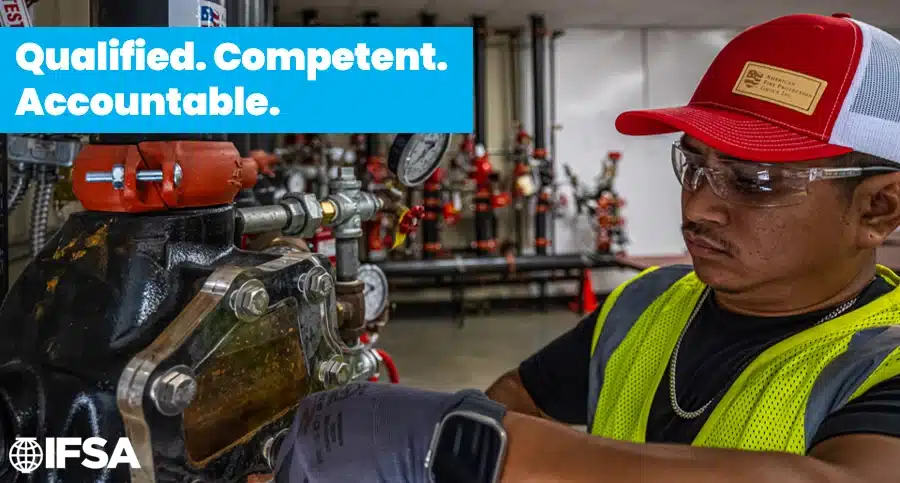 ting, and thorough documentation.
Each task requires specific knowledge to perform correctly and to interpret the results. And critically, when impairments and deficiencies are found, a qualified contractor knows how to prioritize them, what requires immediate action, and how to communicate that urgency to the building owner.
Does NFPA 25 Legally Require Qualified Personnel?
NFPA 25 explicitly requires that inspection, testing, and maintenance be performed by qualified personnel. Section 4.1 places the responsibility squarely on the owner: you are accountable for ensuring the system is maintained in an operable condition. The standard leaves no ambiguity about who is qualified to do that work.
Local AHJs—fire marshals, fire prevention bureaus, and building departments—enforce these requirements and have the authority to require documentation of qualifications. In the event of a fire loss, investigators will examine ITM records closely.
How to Choose a Fire Sprinkler ITM Contractor
When selecting a contractor, ask the right questions:
- What certification(s) does the company hold in fire protection?
- Do their technicians hold certification from a recognized certifying agency, and at what level?
- Are they familiar with your specific system type (wet pipe, dry pipe, pre-action, deluge)?
- Will they provide written inspection reports that document every item checked and every impairment and deficiency found?
- Will they clearly communicate and recommended corrective actions?
A reputable contractor will welcome these questions. Any resistance to answering them clearly is a warning flag.
The Bottom Line
Fire sprinkler systems save lives and protect property—but only when they work. The inspection, testing, and maintenance that keeps them ready to perform is not a checkbox exercise or a cost center to be minimized. It is a critical safety function that requires genuine expertise.
Hiring unqualified personnel—whether to save money, out of convenience, or simply not knowing any better—puts occupants at risk, exposes building owners to legal and financial liability, and undermines the entire purpose of having a fire protection system in the first place.
When it comes to fire protection, qualified isn’t a preference. It’s a requirement.
For additional information, see: NFPA, “U.S. Experience with Sprinklers” (T. McGree, April 2024), NFPA No. USS14, based on 2017–2021 NFIRS data.