
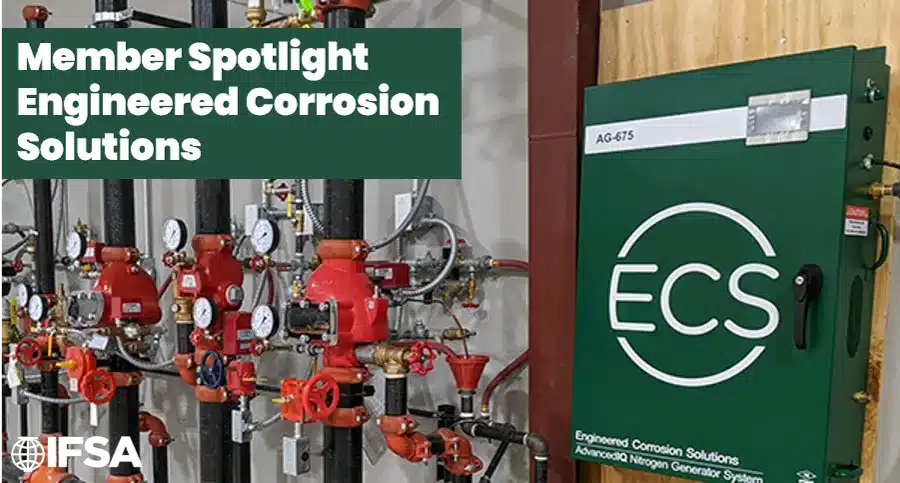
In September 2008, a team of engineers in St. Louis, Missouri, set out to build on a finding that ran against the accepted thinking of the time: the primary cause of corrosion inside fire sprinkler piping was oxygen, not microbiologically influenced corrosion (MIC). Founder Jeff Kochelek presented the concept to the industry, describing how a nitrogen generator paired with a vent could purge oxygen from dry pipe and preaction systems and hold the piping under nitrogen instead. Nitrogen inerting is now widely specified and recognized as the industry standard for safe and effective means of corrosion control for water-based fire sprinkler systems protecting all types of facilities, including critical infrastructure facilities such as data centers and cold storage. Engineered Corrosion Solutions (ECS) remains the company that brought the approach to the fire sprinkler industry.
Engineers Who Went Looking for the Cause
ECS began as Fire Protection Systems Corrosion Management, Inc., known as fpsCMI, incorporated in St. Louis in January 2003. Its founders were design-firm engineers whose large retail client needed a corrosion control device that could be shown to work, and they found that no one in the market could provide a proven solution. They spent the next five years designing and engineering their own suite of corrosion management products.
The work did not stop at products. Treating the damage in a corroded system does little good if the reaction causing it continues, so the team set out to find the root cause. At the time, much of the industry attributed sprinkler corrosion to MIC and built treatment programs around that explanation. The ECS engineers concluded that oxygen trapped in the piping was the driver. Remove the oxygen, and the oxygen corrosion reaction cannot proceed.
That conclusion produced a patented process for inerting sprinkler systems with nitrogen gas, and later a series of U.S. patents covering the use of a nitrogen generator with a vent on dry pipe and preaction systems.
Taking the Science into Wet Pipe Systems
In 2009, ECS applied the same reasoning to wet pipe systems. A wet system still holds pockets of trapped air after it is filled, and that air keeps oxygen in contact with the pipe wall. ECS developed equipment and methods to purge wet systems with nitrogen, first at the Philadelphia Museum of Art, where the approach resolved the museum’s corrosion problem.
FM Global then asked ECS to assist one of its clients, a major defense contractor whose twenty-five wet systems protected approximately 92,900 m2 (1,000,000 ft2) of satellite manufacturing space. The facility was averaging one leak per week. Wet Pipe Nitrogen Inerting stopped the leaks completely, and no pipe had to be replaced.
That outcome matters beyond the cost of a repair. Every leak in a sprinkler system is also an impairment, a period when part of a building is without protection while the pipe is drained and repaired, and a pattern of repeated leaks pushes owners toward questioning whether the system is worth keeping at all. A system that stops leaking is a system that stays in service.
A New Name and Independent Recognition
In March 2013, the fpsCMI management team partnered with a group of private investors to acquire the company from its original shareholders, and the business took the name Engineered Corrosion Solutions. Independent recognition followed. In February 2016, the ECS Protector line of nitrogen generators became FM Approved under FM Approvals Standard 1035, the approval criteria developed for nitrogen generators serving dry pipe and preaction systems, making them the first FM Approved nitrogen generators available to the fire sprinkler industry.
In 2021, ECS completed a review of its entire business and earned ISO 9001:2015 certification for its quality management system through the Performance Review Institute (PRI) Registrar. The company treats that certification as an ongoing commitment to continuous improvement rather than a one-time achievement.
Measuring What Happens Inside the Pipe
Corrosion control is only as good as the ability to confirm it is working. Many corrosion monitoring devices are mounted at the riser, where they are easy to reach and easy to read. ECS engineers determined that riser-mounted devices do not accurately represent the corrosion activity taking place out in the system piping. This is the risk an owner would not expect: a monitor at the riser can report a quiet system while the branch lines continue to lose wall thickness.
In 2015, ECS introduced the In-Line Corrosion Detector, designed to be installed in the system piping itself, and received a U.S. patent on the design. In 2017, NACE, then the National Association of Corrosion Engineers and now part of the Association for Materials Protection and Performance (AMPP), recognized the detector as a Corrosion Innovation of the Year.
When a system is already leaking, or when an owner is weighing full pipe replacement, ECS evaluates the actual condition of the pipe. Corrosion risk assessments combine video scoping with analysis of pipe samples. A pipe analysis identifies the type of corrosion, measures remaining wall thickness and pit depth, and reports the most likely cause of failure along with remediation and prevention recommendations. The results can supplement the five-year internal pipe assessment required by NFPA 25, the Standard for the Inspection, Testing, and Maintenance of Water-Based Fire Protection Systems. In many cases the evidence shows that a system can be protected and kept in service with targeted repairs rather than replaced outright.
One Reaction, a Complete Product Family
Every product ECS makes addresses the root cause of most fire protection failures: the oxygen corrosion reaction. For dry pipe and preaction systems, nitrogen generators take the place of the conventional air compressor as the source of supervisory gas. Wall-mount models serve systems with up to 13,250 L (3,500 gal) of total capacity, and stand-alone models serve up to 94,600 L (25,000 gal).
Each riser pairs the generator with a vent installed in the riser room. The Protector Vent (PAV-D) is closed manually once the system reaches 98 percent nitrogen, which the patented fill and purge process achieves within about two weeks. The AdvancedIQ Vent Controller goes further, controlling venting while continuously monitoring and logging nitrogen purity and system pressure over time.
For wet pipe systems, the Automatic Air Vent (PAV-W) releases trapped air as the system fills, and supervised versions connect to the fire alarm system or building management system. Where the risk warrants it, ECS nitrogen inerting vents allow wet systems to be purged with nitrogen, and field tools such as the PHGA-1 Handheld Gas Analyzer confirm that the target purity has been reached. ECS products are built by the company’s production team and shipped from its headquarters in St. Louis.
Teaching the Science Behind the Solution
ECS has long held that corrosion control succeeds only when the people who design and maintain sprinkler systems understand why pipe corrodes. ECS University offers tuition-free training on that subject. The in-person program is a two-day course at the St. Louis headquarters with hands-on instruction in nitrogen generator operation, while ECSU Online is an on-demand course that professionals can complete at their own pace from anywhere. One-hour Training Thursday webinars address individual subjects live, with direct access to the instructor. The program is approved for continuing education by the California State Fire Marshal, and graduates receive a certificate of completion.
“ECS started because a group of engineers asked why sprinkler pipe was failing and then followed the evidence wherever it led. That habit still guides us. Every product we build exists for one purpose, to safely keep a fire sprinkler system intact and ready for the day it has to work. We joined IFSA because corrosion is a global problem, and the industry is better served when the science is shared openly with fire protection professionals around the world.”
Andrew Loeffelman, Vice President of Sales, Engineered Corrosion Solutions
A fire sprinkler system may sit untouched for decades before it is called on, and on that day the water can only reach the fire through pipe that is still sound. That condition is decided long before the fire.
Engineered Corrosion Solutions is a proud member of the International Fire Suppression Alliance. To learn more, visit www.ecscorrosion.com.