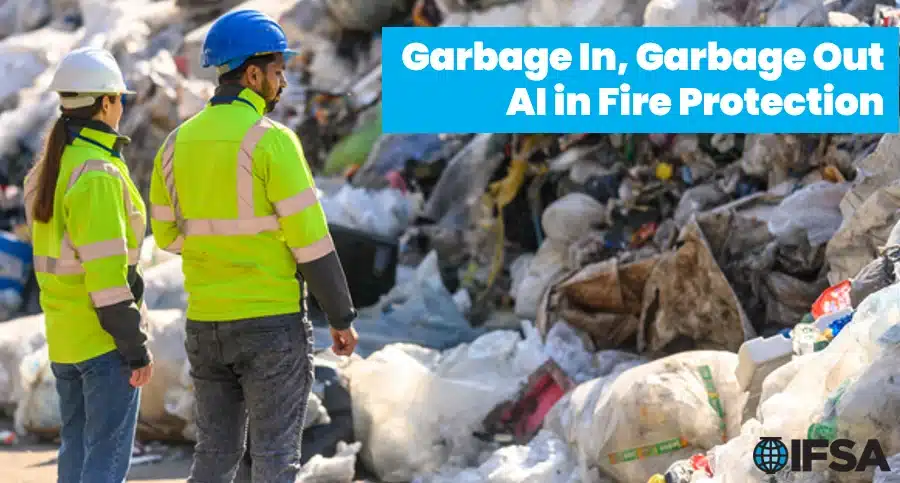
There is an old saying in computing that goes back to the earliest mainframes. Garbage in, garbage out. It means that a machine can only work with what you give it, and if you feed it flawed information, it will hand you flawed answers with complete confidence. That principle has never mattered more than it does now, as artificial intelligence begins to appear in the tools we use to design, install, and inspect fire protection systems. The technology is impressive. The data underneath it decides everything.
Why data quality matters in fire protection
 Fire protection is a discipline built on getting the details right. A design professional sizing a system to NFPA 13 is working from a body of knowledge that has been tested against real fires, real failures, and real losses of life. When we ask an AI tool to help with that work, we are asking it to draw on whatever information it was trained on. If that information is current, accurate, and grounded in the codes we actually use, the tool can be a genuine help. If it is outdated, incomplete, or scraped from unverified corners of the internet, the tool becomes a source of quiet, confident error. And confident error is the most dangerous kind in a life-safety application.
What data quality means for AI in life-safety systems
Consider what “data quality” actually means in our world. It means the edition of the standard matters. A model trained on a superseded edition of NFPA 13 may cite spacing rules or hazard classifications that no longer apply. It means the source matters. Guidance pulled from a manufacturer’s installation manual carries different weight than a comment thread on a forum, yet an AI system that cannot tell the difference will treat both as equally true. It means context matters. A rule that is correct for a light hazard occupancy can be wrong, even dangerous, when applied to a storage arrangement it was never meant to cover. The machine does not know the difference unless the data taught it the difference.
How NFPA and NFSA are building AI on authoritative sources
This is where the industry is beginning to do something worth noticing. NFPA and NFSA have started building AI tools grounded in authoritative sources rather than the open web. NFPA describes its CASI assistant, launched inside NFPA LiNK, as an answer users can trust because it is grounded in official NFPA content and returns citations to the source passages it relied on (NFPA, 2026). NFSA has taken a similar path with its Chat EOD tool for engineering and design questions. When a tool draws its answers from the actual body of codes and standards, the quality of the input rises sharply, and the output becomes something a professional can begin to work with. That grounding is the whole point. It is the difference between a tool that guesses and a tool that reasons from the same documents you would reach for on the shelf. The value of these efforts is not that they are powered by AI. The value is that someone took care with what went into them.
The hallucination problem when data is poor
Contrast that with what happens when the data is poor. A general-purpose model, asked a fire protection question, will often produce an answer that sounds authoritative and reads well. It may reference a standard by name. It may use the right vocabulary. And it may be wrong in ways that only an experienced professional would catch. This is the hallucination problem, and it is not a rare glitch. It is a predictable result of asking a system to speak beyond what its data can support. The system is not lying. It has no concept of truth. It is assembling a plausible response from patterns, and when the underlying patterns are thin or flawed, the response is thin or flawed too, dressed up in fluent language that hides the gap. The legal profession learned this in public when two attorneys submitted a court filing built on cases an AI tool had invented, and the judge sanctioned them for it (Mata v. Avianca). The fabricated citations looked real. They simply did not exist.
Professional accountability and the standard of care
The stakes make this more than a technical curiosity. In our field a mistake does not stay on the screen. It becomes a design that gets stamped, a system that gets installed, a building that gets occupied. The PE of record who seals a drawing is accepting professional responsibility for it, and no AI tool shares that responsibility. If the data feeding the tool was garbage, the professional still owns the outcome. That is a sobering thought, and it should shape how every one of us approaches these tools. We are accountable for what we produce, whatever helped us produce it.
Good practice for using AI tools in fire protection
So what does good practice look like as these tools arrive? It starts with knowing where the answer came from. A tool that can show its sources, cite the actual standard, and point you to the passage it relied on is far more useful than one that simply asserts. It continues with verification. Every output from an AI system should be checked against the governing code the same way you would check the work of a junior colleague, because that is essentially what you are doing. And it depends on judgment, the kind that comes from years of doing the work, that lets an experienced designer sense when an answer feels wrong even before they can say why. That instinct is not something the machine can replace. It is the last line of defense when the data lets us down.
Data quality determines whether AI protects lives
None of this is a reason to turn away from the technology. The tools grounded in authoritative sources are already showing what careful data can do, and they will get better. The point is simpler and older than any of them. A tool is only as good as what you put into it. In most fields a poor answer is an inconvenience. In ours it can put people at risk. That is why data quality is not a background concern for our profession. It is the concern that determines whether these tools help us protect lives or quietly undermine the standard of care we have spent decades building.
The machines will keep improving. Our obligation stays the same. The fire engineering community has already signaled where its attention belongs. At the SFPE AI in Fire Engineering Summit I attended in Berkeley in 2025, verification and validation stood out as a shared priority among the professionals in the room. The people who occupy the buildings we protect are counting on work we have checked ourselves, not answers a machine handed us on faith. Garbage in, garbage out was true for the mainframe operators who coined the phrase. It is just as true today, and the cost of forgetting it has never been higher.
References
Chat EOD: Developed by the industry, for the industry. https://nfsa.org/2025/11/06/chat-eod-developed-by-the-industry-for-the-industry/
NFPA unveils NFPA LiNK 3.0, advancing digital transformation in fire and life safety. https://www.nfpa.org/about-nfpa/press-room/news-releases/2026/nfpa-unveils-nfpa-link-3-0-advancing-digital-transformation-in-fire-and-life-safety
Practical Lessons from the Attorney AI Missteps in Mata v. Avianca. https://www.acc.com/resource-library/practical-lessons-attorney-ai-missteps-mata-v-avianca
Reflecting on the 2025 AI in Fire Engineering Summit. https://www.sfpe.org/blogs/amanda-tarbet/2025/08/01/2025-ai-in-fire-engineering-summ