TRAINING
Log in or use the form below to register and access training videos and other content related to fire suppression.
Professional Development
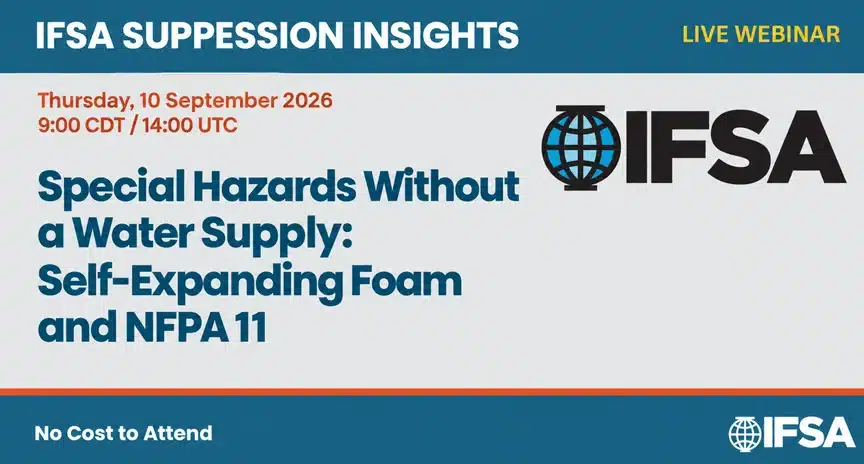
Thursday, Sep 10, 2026 | 09:00 AM in Central Time (US and Canada)
Many of the hazards that most need foam protection sit where infrastructure is hardest to justify. Remote tank farms, loading racks, mining equipment, and offshore decks often carry no municipal water supply and no realistic path to underground fire service mains, and the capital cost of building that infrastructure has left more than a few risks unprotected. Self-expanding firefighting foam approaches the problem from a different direction. A pre-mixed solution of potable water and listed fluorine-free concentrate is charged with inert gas inside an ASME pressure vessel and held ready for discharge, so the system operates without a fire pump, without stored water, without a concentrate tank, and without proportioning equipment. NFPA 11 permits systems of this type to operate without a permanent or automatic water supply.
This program is written for engineers who specify special hazards protection and for the owners and risk managers who fund it. Presented material covers the hazards and industries where the technology has been applied, the way a self-pressurized pre-mixed solution changes hydraulic calculations and application rates, what inspection and maintenance look like across a service life, how the installed and life-cycle cost compares with a conventional foam-water system, and the questions worth putting to a manufacturer before any new technology enters a specification. Advantages and limitations are presented alongside each other. Innovation is only useful when it is matched to the right hazard.
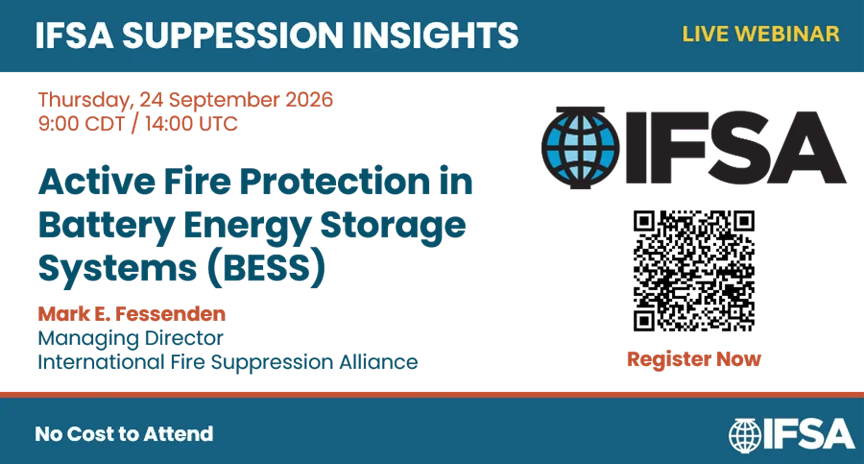
Thursday, Sep 24, 2026 | 09:00 AM in Central Time (US and Canada)
Battery Energy Storage Systems (BESS) are rapidly expanding as part of the global transition to renewable energy, introducing new and complex fire protection challenges. This webinar provides design professionals, fire authorities, and risk specialists with a practical overview of active fire protection strategies for lithium-ion battery hazards.
Participants will explore how thermal runaway events develop, the role of early detection and system response, and how active protection, cooling, and containment approaches can be applied to reduce fire growth and limit consequences.
The session will highlight the importance of system reliability, coordination with emergency response planning, and the evolving regulatory landscape influencing BESS fire protection.